
Seasons – Spring 2026
Welcome to Seasons, a quarterly newsletter designed to help Texas landowners stay informed, inspired, and in tune with the land throughout the year.
Spring Activities: Getting Started
Spring, the time to be out on your land and see all the new opportunities it holds. If you didn’t get started on your qualifying activities this Winter, now is an essential time to get things moving. We’ve broken down our most common and attainable activities to help you understand the importance of executing them at this time of year. Plus, now is the time to get out and discover all your land has to offer. Fresh growth, new and familiar species – all are at your fingertips when you dive into the beauties of the land. For those of you just starting wildlife management or thinking about new activities, this article has some helpful tips.
Habitat Control: Habitat Control can mean a lot of different things. If it is in your wildlife plan, it’s an important category for your Wildlife Management Valuation. Grazing management, prescribed burning, and brush management are all great options to consider whether they are currently in your plan or not. Recently, Wildlife Biologist, Taylor Garrison, was featured on an episode of Your Texas Land to talk through grazing with purpose and how factors of rainfall, geography, and stocking rates influence habitat health. If this is an area you are interested in, it’s a must-see or “hear” episode that gives you the basics to set you up for success, particularly if you have maintained some cattle or want to utilize livestock from time to time.
Brush management is another commonly chosen activity by landowners due to all the benefits it can provide. Ensuring a healthy, diverse ecosystem improves the quality of forbs and native grasses that are important for soil health and as food sources for the wildlife in your area. So, what do you do? In short, target overgrowth of native brush species with a chainsaw and/or herbicide. Sounds easy enough. However, having a structured plan that includes which species to target and why, what area you are going to tackle first, and how you execute the process all affects how effective brush management is. Your wildlife plan should provide good guidance, but some common mistakes include removing too much of a beneficial species or targeting low priority areas, using the wrong equipment, herbicide or technique, and poor timing. Sometimes a project needs to be handed off to professionals who know the ins and outs of what makes this treatment so successful. Interested in executing brush management but feeling overwhelmed? Watch our newest video and see how our team tackles somewhat intimidating non-native brush species and sets you up for future success.
Supplemental Water: The rain this time of year can be unpredictable. Times of drought and drier seasons are critical times for the wildlife you are managing on your property. Help them out by setting up a proper supplemental water station. Sources like troughs and water tables need to be checked regularly to ensure they are actively working and ready for the season ahead. This is the time to repair or update your current stations before the summer months hit and the temperatures rise.
Supplemental Food: What goes along with supplemental water? Supplemental Food. Improving the distribution of food on your property ensures wildlife can take advantage of all available habitats. Help them out with a Ground Feeder, Protein Block Feeder, or our favorite, the Platform Wild Bird & Turkey Feeder. These are free-choice feeders, meaning wildlife can access food on demand, so they qualify as an activity in this category. Large capacity feeders can be a low maintenance project that attracts wildlife for your viewing pleasure. They are also great for monitoring with trail cameras as a census activity.
Spring Breeding Bird Surveys: Birding is fun! This is the time to see what birds breed and migrate through your property. From Purple Martins and Painted Buntings to Scissor-Tailed Flycatchers, this time of year is a prime time to see birds in action after the colder temps. Many landowners enjoy the connection that comes from learning about the birds that live and raise young on their property. While you can admire the birds all spring, don’t forget that conducting a bird survey on your property also counts as one of your Wildlife Management activities. Checking something off the list and enjoying it at the same time? Sign us up!
Predator Control: Spring rains bring welcome new growth but also Imported Red Fire Ant mounds. These insects are disruptive to native wildlife; they prey on ground-nesting birds, insects, and small mammals of all kinds and compete with them for food resources. Along with affecting the sought after animals most landowners want to see on their property, the mounds can reduce land usability if they aren’t managed. Enjoying your property becomes harder when a walk might mean fighting of a swarm of fire ants on your leg. Control them now while they are most active.
Hogs, hogs, hogs. If you don’t have them, that’s good news, but you may have them soon! The ever-invasive feral hog can cause serious damage, predation problems, and unwanted competition for wildlife and livestock for food. Traps that target the entire sounder are one of the most effective ways to manage them. Stressed? There is a solution available, a Pig Brig®Trap System. If you are prepared to tackle the problem, the Pig Brig® Trap System is a patented net trap designed by wildlife scientists that is built with landowners in mind. No gates to monitor, multi-catch design, and a durable net that is proven to work. Pig damages escalate fast, learn more from our team on why this trap is a strategy that works.
Whatever you do, make sure you’re staying compliant by keeping up with your activities and be sure to get out on your land to enjoy it during this beautiful time of year. Life happens and things pop up, so knock a few more things off your list and enjoy the fruits of your labor.
April 30th is Days Away!
 You still have options to maintain the same Ag property tax valuation if you haven’t made any moves yet.
You can file late: If you would like to convert to Wildlife Management in 2026, you can file late or ask for an extension from your appraisal district. A 10% tax penalty for filing late may apply but our team of experts can help you calculate the penalty fee for your property.
You can purchase early: Secure your future today with a 2027 plan. By investing in a 2027 plan now, you’ll stay ahead of the curve and enjoy peace of mind knowing you’re not scrambling at the last minute. Plus you save money! Our team will arrange a meeting with a Wildlife Biologist this summer to finalize your plan and ensure your application is filed by January 2027.
Our team is ready to talk to you! Give us a call.
Lately on Your Texas Land
The past few months you’ve heard episodes from frequently asked questions most landowners ask, to a two-part sit down with Romey Swanson. Your Texas Land is a place that we are taking a deep dive into all things related to land in Texas. We want feedback! What do you want to hear next? Email us here and suggest a topic you would want our team to tackle next.
Haven’t listened? Subscribe and follow us today on Spotify, Apple Podcasts or wherever you listen to be the first to hear from our partners and team on issues that most landowners face daily.

Let The Land Speak – Grazing with Purpose
 Landowner Legacy and the Devils River with Romey Swanson
 Owls, Lions, and a Herping Big Year – Part 2 with Romey Swanson
Landowner Testimonial: Jan Gunter
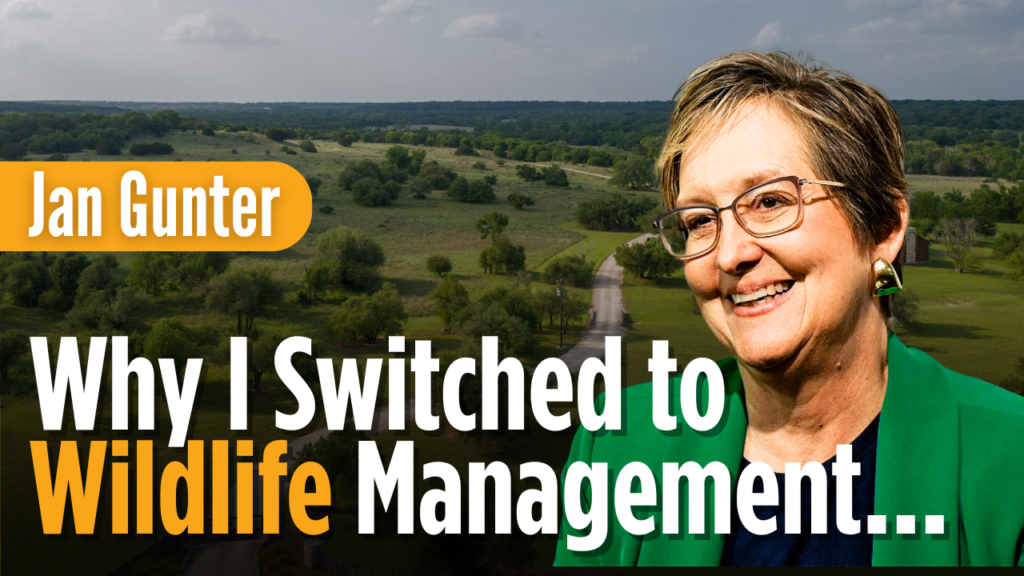
Transitioning from traditional agricultural use to Wildlife Management can feel like a big leap but for many Texas landowners, it’s a practical and rewarding path forward. In this client spotlight, Milam County landowner Jan Gunter shares her firsthand experience converting her 200-acre property from Ag Valuation to Wildlife Management under 1-d-1 Open Space Valuation. Her story offers a real-world look at what the process actually involves from developing a Wildlife Management plan to implementing qualifying habitat practices and staying compliant with appraisal district requirements. It’s an honest look at how Wildlife Management isn’t a shortcut, but a thoughtful, long-term approach to stewarding your land while maintaining your tax valuation.
American Woodcock: More Than Meets The Eye
Featured Article from Tucker Slack, Wildlife Biologist
As a boy I remember almost everyone having a carefully selected nickname that highlighted their most unique traits (in a positive way, of course). The reasoning behind the nickname selection process was very complex and difficult to explain, much like young boys. Regardless of the name or how it was derived, the slightest hint of disapproval instantly cemented the nickname to that person for life, or at least until Junior High School, where the process would start anew. One nickname was almost always sufficient, and I don’t recall anyone ever having (or needing) multiple nicknames.
This is not the case for the American woodcock (Scolopax minor). The list of commonly used names includes: timberdoodle, bog snipe, brush snipe, Labrador twister, night partridge, big-eye, and bogsucker, to name a few. These distinct names affirm the woodcock’s originality, and accurately describe its appearance and behavior. No matter what you call this intriguing bird, it is definitely in a league all its own.
Scientists place the American woodcock in the Family Scolopacidae, which includes more than 80 species of shorebirds distributed around the globe. However, as the name woodcock implies, this bird doesn’t exactly spend his days basking on the beach. They inhabit young, moist woodlands in the eastern half of Texas, mainly as winter residents. Upon the arrival of spring, many of these migrants return north. However the extreme eastern portion of Texas does have some yearlong residents.
A timberdoodle’s camouflage plumage is second to none as it allows these birds to all but disappear in the leaf litter on the forest floor. Once heavily hunted throughout East Texas, most encounters are now incidental. Woodcock usually walk around on the ground undetected, but will flush if pressured.
Overall, they are a little larger than a bobwhite quail, and sexes are similar in appearance with females slightly larger and heavier. These “husky” birds have large eyes that are set well back on the sides of their head, enabling them to detect danger from any direction. Their nostrils are positioned high on their long, thin bill which allows them to breathe while probing the soft earth for sustenance. Their ears are located in front of their eyes, and their brain arrangement is also unique among birds.
Woodcock are outfitted with specialized feeding equipment, including an upper bill that can be opened and shut while underground and a long, rough tongue used to apprehend earthworms, which comprise about 2/3 of their diet. Their remaining nourishment comes in the form of insects, arachnids, invertebrates, and small seeds. Woodcock have voracious appetites, and an adult can consume more than their own weight in food daily.
One of the most exceptional behaviors is the male’s elaborate courtship display which takes place near dusk and dawn, when the lighting is just right for romance. This bird’s peculiar appearance and interesting behavior has gained notoriety among bird enthusiasts and outdoor lovers throughout our state, and helped to secure its well-deserved catalog of colorful nicknames.



Sorry, the comment form is closed at this time.